
FireBlock PV Membrane
Pitched Roof – Under Roofing (California Solution)

Bridgehill FireBlock Membrane: Pitched Roof Underlayment for Wildfire & Solar Fire Protection
Bridgehill FireBlock is a fire-resistant roof membrane engineered for pitched roof constructions in wildfire- and ember-prone areas. Installed directly above the wooden roof deck and beneath the outer roofing layer, it creates a sealed fire barrier within the roof assembly.
When exposed to extreme heat from solar panel fires, airborne embers, or external flame contact, FireBlock activates and expands to block flames, radiant heat, and hot gases. This helps prevent ignition of combustible insulation, protects load-bearing structures, and reduces the risk of structural fire spread.


Active Expansion
When exposed to extreme heat, the membrane rapidly expands to form an insulating barrier layer. This reaction is triggered by intumescent technology built into the material.
Thermal Shielding
The expansion creates a dense, heat-resistant barrier that prevents flames, radiant heat, and hot gases from reaching the insulation and structural layers below.
Roof Preservation
By blocking thermal transfer, the membrane helps maintain the integrity of the roof deck, preventing ignition of combustible materials and structural collapse.
Fre Safety Layer
Bridgehill FireBlock Membrane functions as a fire safety layer, protecting roof structures from wildfire heat and wind-driven embers.
Bridgehill FireBlock Products


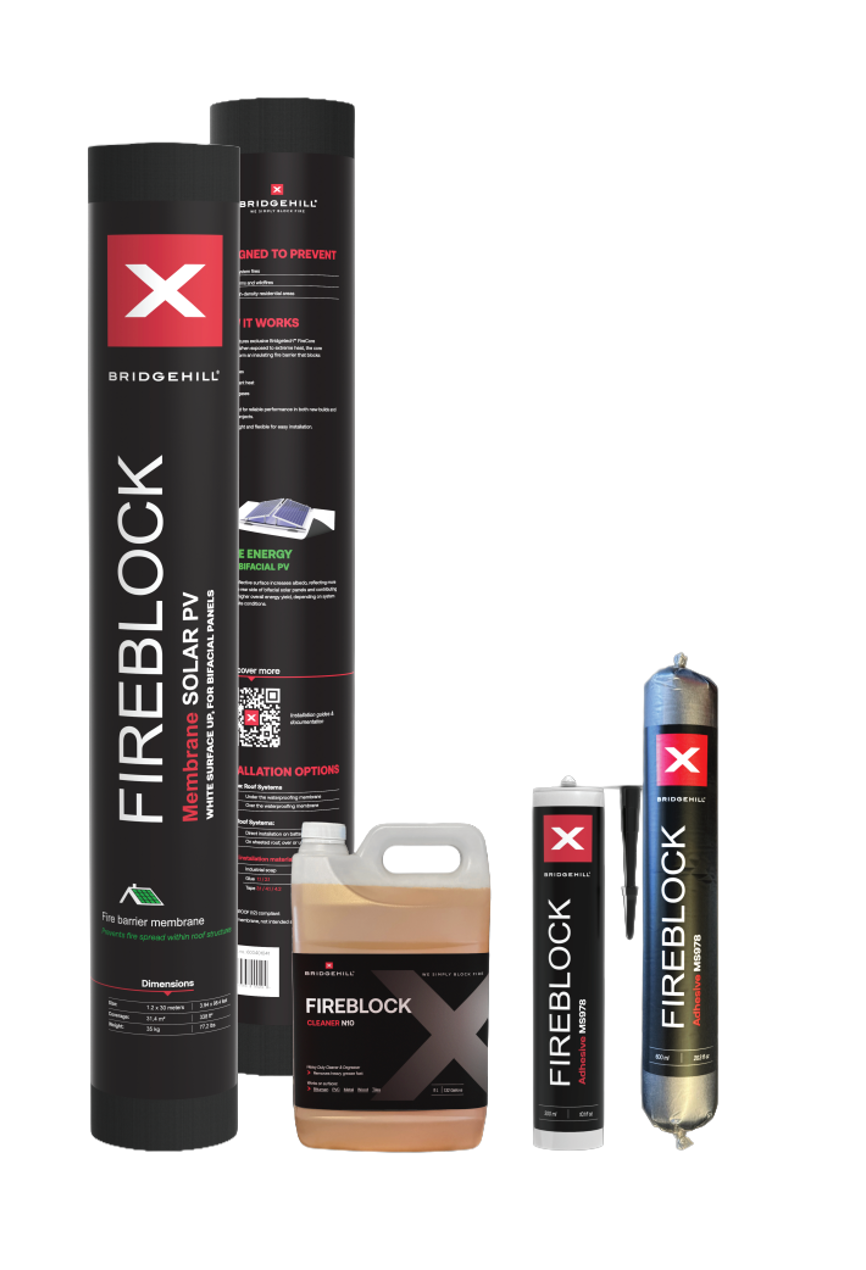
FireBlock Solar PV Membrane is a fire-resistant roof membrane designed to prevent fire from spreading from rooftop solar panels into the underlying roof structure.
It functions as a passive fire barrier within the roof assembly. When exposed to high temperatures, it expands and forms an insulating layer that blocks flames, radiant heat, and hot gases from penetrating combustible insulation such as PIR and EPS.
During ember attack, wind-driven burning particles can enter gaps under panels and ignite roofing materials. FireBlock blocks embers and prevents them from reaching combustible layers in the roof assembly.
When exposed to high heat, the membrane expands and forms an insulating barrier that limits flame spread and heat transfer downward.
No. FireBlock does not replace Class A roofing requirements.
It complements a Class A roof assembly by adding an additional fire barrier beneath the solar panels. This is particularly relevant because rooftop PV installations can alter the fire performance of a roof system.
FireBlock is used as a documented risk-reduction measure within a compliant roof assembly.
Yes. FireBlock has been tested in full-scale fire scenarios simulating solar panel fires and prolonged flame exposure.
Testing includes combustible insulation such as PIR and EPS, and results show that underlying materials remained below ignition levels during sustained fire conditions.
It is designed to maintain structural integrity during high-temperature exposure typical of severe fire events.
FireBlock activates when exposed to extreme heat and expands through an intumescent reaction.
This expansion creates a thick insulating barrier that significantly reduces heat transfer and prevents downward flame spread into the roof construction
Related articles


